
Blog/Is PSA grading worth it?
Grading
Is PSA grading worth it? The math on 125 cards' market prices
A PSA 10 sells for more than a raw card. Whether that covers the fee depends on the card's price, and on how sure you are of a 10.
The short version
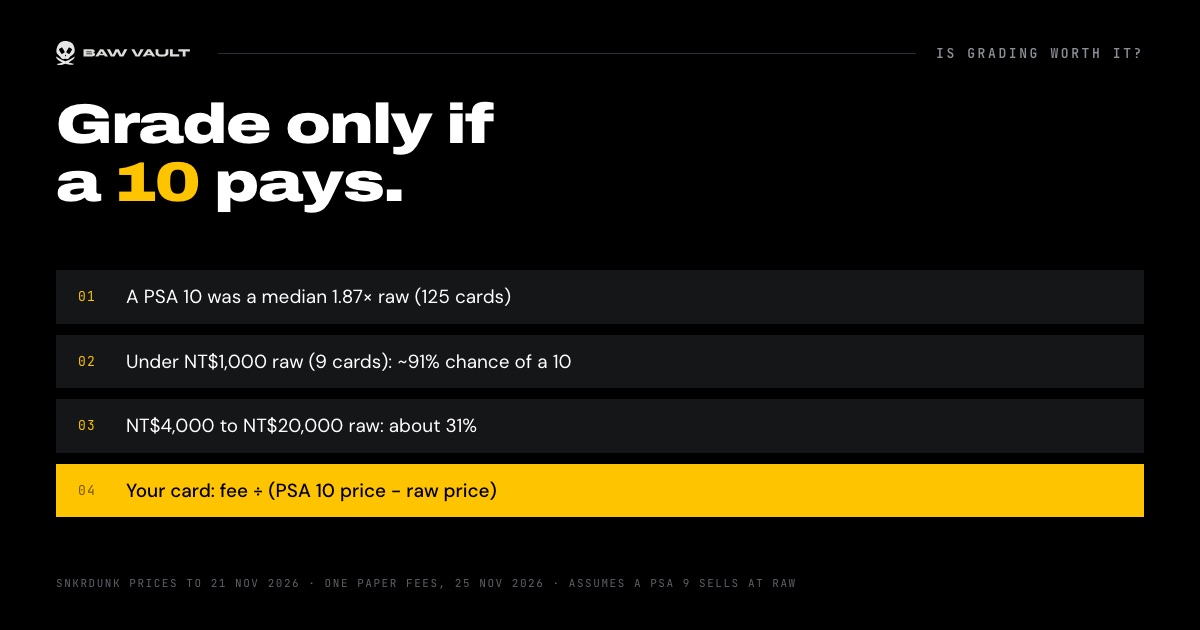
- On 125 cards with enough recent sales, a PSA 10's market price was a median 1.87 times the raw price.
- Cheap cards gain the biggest multiple but the least money: under NT$1,000 raw, a PSA 10 was worth about NT$2,000 more.
- Through a Taiwan submission service, the 9 cards under NT$1,000 raw needed about a 91% chance of a 10 just to cover the fee. Between NT$4,000 and NT$20,000, about 31%.
- That assumes a PSA 9 sells for about the raw price. In my experience a 9 is hard to sell in Taiwan, so treat these as the lowest bar.
- Check your own card: the chance you need is the fee divided by the PSA 10 price minus the raw price.
I am Singaporean and buy and sell cards out of Kaohsiung, and my buylist tracks recent SNKRDUNK prices for raw and PSA 10 copies of the same cards. This post puts those prices against what grading costs. How to actually send cards to PSA from Asia, with my own receipts, is in PSA grading from Asia.
Each price is SNKRDUNK's market price up to 21 November 2026: the median of recent sales, or the cheapest listing if that is lower. Prices are converted at ¥4.84 to NT$1, and the fees are from One Paper, a Taiwan submission service, on 25 November 2026. They are a reference market, not Taiwan street prices.
How much more a PSA 10 is worth than raw
Across 125 cards, a PSA 10 was priced at a median 1.87 times the raw card; half the cards fell between about 1.6 and 2.4 times. The multiple shrinks as the card gets more expensive, but the money goes the other way.
| Raw price (NT$) | Cards | PSA 10 ÷ raw, median | PSA 10 minus raw, median |
|---|---|---|---|
| Under 1,000 | 9 | 3.3× | NT$2,066 |
| 1,000 to 4,000 | 36 | 2.2× | NT$2,397 |
| 4,000 to 20,000 | 56 | 1.7× | NT$6,539 |
| 20,000 and up | 24 | 1.4× | NT$21,178 |
| All 125 | 125 | 1.87× | NT$4,793 |
One Piece cards were 113 of the 125, at a median 1.78 times. The 12 Pokémon cards came out higher, at 2.28 times, but 12 cards is too few to lean on.
What grading a card costs, and why it climbs with the card
PSA charges by tier, and each tier has a maximum declared value. A card that comes back worth more than its tier's cap is billed for the higher tier, so the honest fee is the tier that covers what the card is worth as a PSA 10.
Through One Paper in Taichung on 25 November 2026, PSA US cost NT$1,800 a card for Value, NT$2,300 for Standard, NT$3,000 for Priority, NT$7,000 for Express and NT$12,000 for Super Express. I added NT$80 for return postage inside Taiwan.
To place each card in a tier, I converted its PSA 10 price to US dollars at US$0.0303 per NT$1, the rate my buylist used. Most of these cards fit in Value; the expensive ones did not.
The break-even: how sure of a 10 you need to be
Assume a card that misses a 10 sells for about what it did raw. Then grading pays off on average when your chance of a 10 is at least the fee divided by the PSA 10 premium. A NT$1,880 fee against a NT$4,000 premium needs a 47% chance.
| Raw price (NT$) | Cards | Fee through One Paper, median | PSA 10 minus raw, median | Break-even chance of a 10, median per card |
|---|---|---|---|---|
| Under 1,000 | 9 | NT$1,880 | NT$2,066 | 91% |
| 1,000 to 4,000 | 36 | NT$1,880 | NT$2,397 | 78% |
| 4,000 to 20,000 | 56 | NT$1,880 | NT$6,539 | 31% |
| 20,000 and up | 21 | NT$7,080 | NT$19,628 | 29% |
The last column is each card's own fee divided by its own premium, then the median for the band, so it will not equal the other two columns divided. The first row rests on only 9 cards.
Three cards worth over US$10,000 as a PSA 10 are left out of this table, because they go into PSA's Premium tiers. On 16 of the remaining 122 cards, the gap was smaller than the fee: grading could not pay even with a guaranteed 10.
Five real cards, worked through
| Card | Raw | PSA 10 | PSA tier and One Paper fee | Break-even chance of a 10 |
|---|---|---|---|---|
| OP10-019 Divine Departure, manga art | NT$971 | NT$2,314 | Value, NT$1,880 | Over 100% |
| OP14-029 Tashigi, SP | NT$930 | NT$3,409 | Value, NT$1,880 | 76% |
| OP12-014 Boa Hancock, SP | NT$7,025 | NT$11,777 | Value, NT$1,880 | 40% |
| OP16-073 Borsalino, manga art | NT$27,893 | NT$38,223 | Priority, NT$3,080 | 30% |
| OP17-118 Rocks D. Xebec, SEC parallel | NT$101,240 | NT$142,562 | Super Express, NT$12,080 | 29% |
Prices as of 21 November 2026. The Divine Departure is the trap: a PSA 10 is priced at more than double the raw card, and a 10 still cannot cover the fee. On the Xebec, if a PSA 9 sold for 80% of raw, the 29% would rise to about 53%.
What these numbers leave out
- A PSA 9 is not worth raw. The break-even assumes it is. If a 9 sells below raw, which in my experience is common in Taiwan, the bar is higher, and much higher on expensive cards. The general form is (fee + raw price − PSA 9 price) ÷ (PSA 10 price − PSA 9 price). To run it on your own card, use the grading break-even calculator.
- These are liquid cards on a dealer's list. 125 of the 322 cards on my buylist had at least two recent sales on both sides, and 124 of them are Japanese-language. It is not a market-wide figure, and it says nothing about Chinese-language cards.
- A clean raw card is not a 10. No number here tells you your odds. Only you can judge the card in your hand, starting with the centering.
- Costs not counted: SNKRDUNK's seller fee, shipping to the dealer, the months of waiting, and exchange-rate moves.
- A few cards sell raw for as much as a PSA 10. One Boa Hancock SP (OP07-051) traded raw above its PSA 10 price, and cards like it drop out of the averages.
So which cards should you grade?
- Under about NT$1,000 raw: almost never through a submission service. You would need to be nearly certain of a 10.
- NT$1,000 to NT$4,000: only cards you are confident are 10s, after checking centering, corners, edges and surface.
- NT$4,000 and up: the bar drops to roughly one chance in three on paper, and higher once a 9's real price is counted. This is where the break-even bar is lowest.
- Any card: declare what it would be worth as a 10. Under-declaring only means an upcharge later.
Before you pay, measure the centering with the card centering calculator, and look up the card on the buylist, which shows what I pay for raw and PSA 10 copies.
Questions people ask
Is PSA grading worth it?
For a card you are confident is a 10 and worth more than a few thousand NT$ raw, usually yes on these numbers. For a cheap card, rarely, because the fee eats most of what a 10 adds.
How much more is a PSA 10 worth than a raw card?
On 125 cards' SNKRDUNK prices up to 21 November 2026, a median 1.87 times the raw price. Cheap cards had higher multiples, expensive cards lower ones.
Is it worth grading cheap cards?
Through a Taiwan submission service, the 9 cards under NT$1,000 raw needed about a 91% chance of a 10 to cover the fee, so mostly no.
How I got the numbers
Each price is my buylist's SNKRDUNK reference: the lower of the median of the last 60 days' sales, up to 12, and the cheapest current listing. A card counts only if both its raw and PSA 10 sides had at least two sales in that window, and the prices did not scatter more than 30% around their trend. Using sales alone, without the listing cap, gives 1.86 times, almost the same.
Fees: One Paper's PSA US price list, read 25 November 2026, with each card placed in the tier that covers its PSA 10 value on PSA's price list. Prices: SNKRDUNK sales and listings, as of 21 November 2026.
Read next
PSA grading from Asia: routes, real costs and wait times
How to send the cards that pass, from Taiwan, with dated receipts.
Card centering calculator
Measure the one flaw you can put a number on before you pay to grade.
Card grading companies: PSA, CGC, BGS and TAG, from Taiwan
If the PSA fee is the problem, what the other graders charge.