
Blog/PSA cert lookup
Grading
PSA cert lookup: how to check a graded card is real
Scan the label, match the record to the slab in your hand, then look at the holder. Shown step by step on one of my own slabs.
The short version
- Look up the cert number on PSA's site, or scan the label in the PSA app.
- Match the card, set, number and grade on the record to the slab in your hand.
- On a recent slab, the record includes PSA's own photos of the front and back. Compare the card itself, not only the text.
- A copied label can carry a real number, so a number that checks out is not enough on its own.
- PSA's buyer's guide names frosted edges and a holder that flexes as signs a slab has been opened.
Every PSA slab carries a cert number, and checking it is the fastest way to know what you are paying for. I am Singaporean and buy and sell cards out of Kaohsiung, and these photos are of one of my own slabs. How cards get to PSA in the first place is in PSA grading from Asia.
Step 1: scan the label, or the QR code on the back
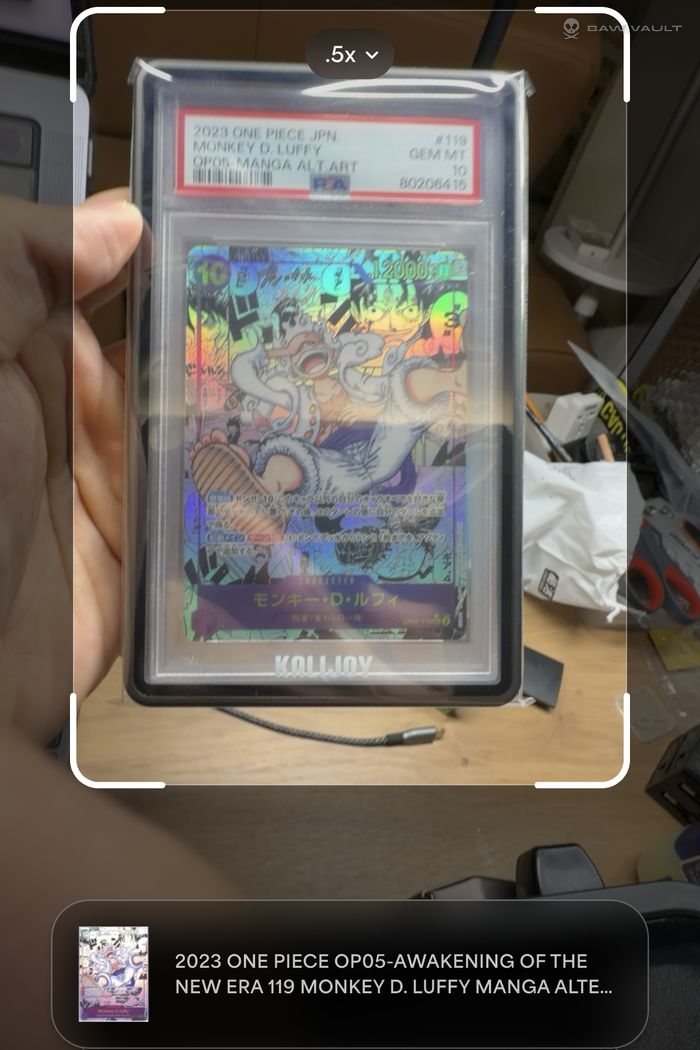
In the PSA app, tap Scan a Card and hold the slab in the frame. The app reads the label and shows the matching record at the bottom of the screen, card name included. You can also search by the cert number.
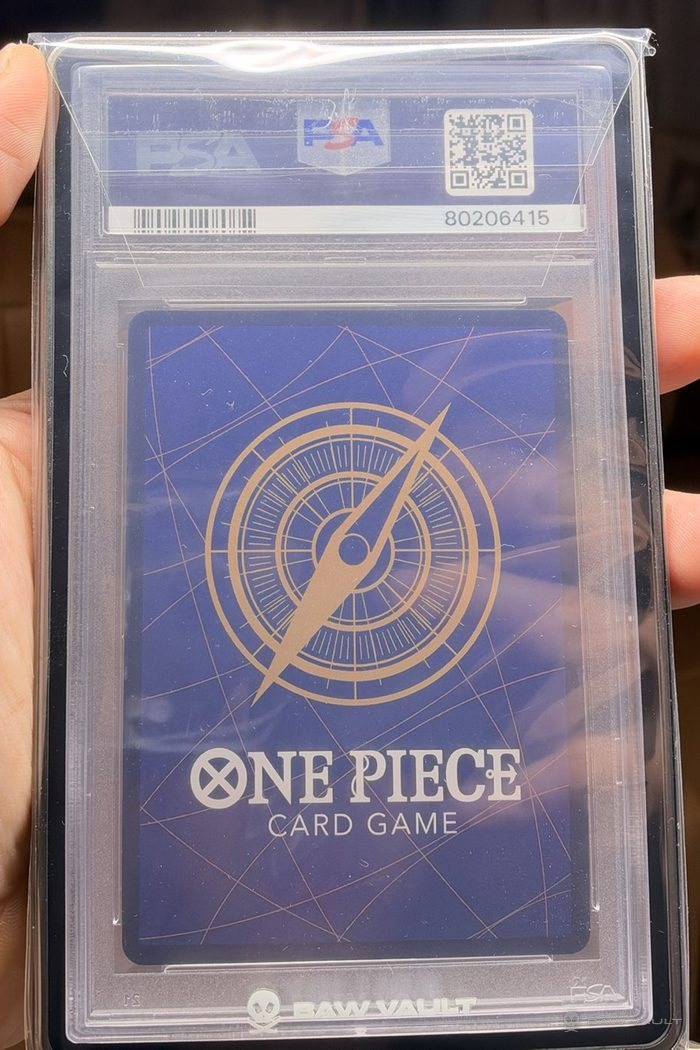
Newer slabs carry a QR code on the back, next to the same cert number. PSA says the code gives instant access to the cert record. Without the app, type the number into PSA's cert verification.
Step 2: match the record to the slab in your hand
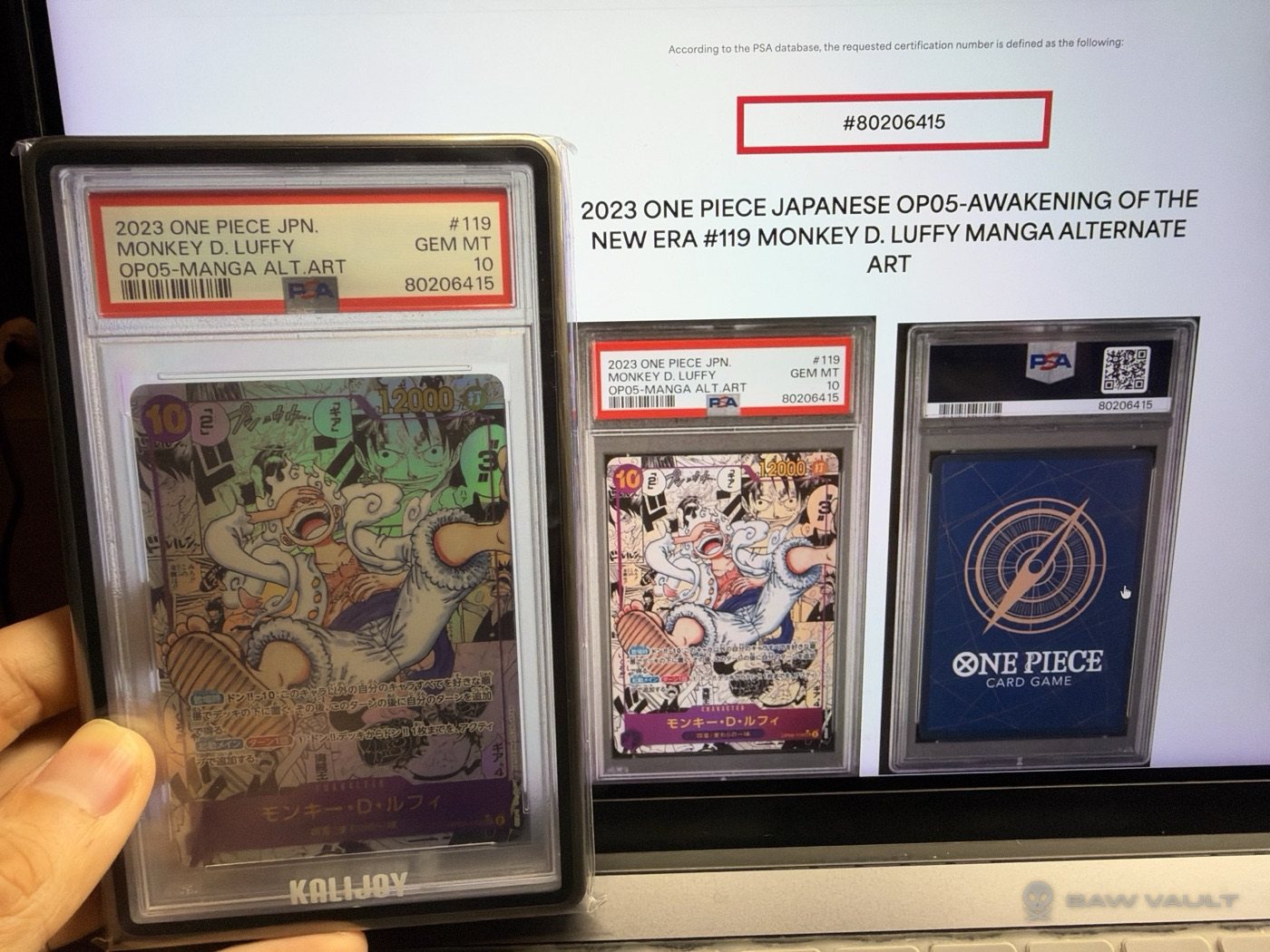
Check that the record matches the slab: the card name, the set, the card number and the grade. A real cert number on a different card means the label or the slab is not what it claims. The photo at the top of this page shows the match on my slab.
On a slab like this one, the record also carries PSA's own photos of the front and back. Compare the card itself with those photos: the centering, the print, any mark. That is the check a copied label cannot pass.
Older slabs may have no photos on the record and no QR code. Then lean on the label and holder checks below, and ask PSA to review the slab before you pay.
How to read the label on a Japanese or Chinese card
The label is in English even when the card is not. On mine, "2023 ONE PIECE JPN." is the year, the game and the language. "OP05-MANGA ALT.ART" is the set and the version, "#119" is the card number and "GEM MT 10" is the grade. The record on PSA's site spells the language out in full, so JPN on the label reads as JAPANESE there.
Check each of those against the card itself. JPN on a card printed in another language, or a card number that differs from the one on the card, is a reason to stop.
Chinese cards carry either a CHI or a CS label, and PSA Japan slabs can look different from US ones. Both are normal. The details are in PSA Japan vs USA slabs.
Step 3: look at the holder
PSA's buyer's guide lists two signs that a holder has been opened: frosting along the edges, and a holder that flexes.
Hold the slab up to a light. PSA says you should be able to see through a real label; a fake front pasted on top is too thick.
Newer labels add, per PSA's security page, an effect that changes under light, ink that resists washing and a UV logo pattern on the back. They help, but a matching record and matching photos come first.
When the number checks out but something is off
- The card does not match PSA's photos. Different centering, a different print or a mark PSA's photos do not show.
- The label looks wrong next to a slab you trust. Thicker, blurrier, a different red, or text that sits differently.
- The holder has frosted edges or flexes. Those are the signs PSA names for a slab that has been opened.
- The seller sends a link or a screenshot instead of the number. Ask for the number and look it up yourself.
If any of these turns up, stop before you pay. PSA's buyer's guide says to know your seller, and that you can ask PSA to review an item before you buy it.
Buying a slab in Taiwan: a short checklist
- Get the cert number and look it up yourself, on PSA's site or in the app, not through a link the seller sends.
- Ask for clear front and back photos and compare them with PSA's photos on the record.
- Meeting in person: check the holder under a light, and scan the label, before any money changes hands.
- Buying online: keep the chat, the listing and the cert number together, so you can show what you were sold.
Selling one instead? A record that matches makes any sale simpler, and the buylist shows what BAW VAULT pays for PSA 10s.
Checking CGC, TAG and BGS slabs
CGC and TAG run their own lookups: CGC's cert lookup and TAG's cert search, which also opens TAG's imaging report for the card. Beckett runs a cert lookup on its own site too.
A grader with no public lookup at all is a reason to walk away. The other checks are in how I judge a grader.
Questions people ask
Is the QR code on a PSA slab proof that it is real?
No. It opens the record for that cert number. A copied label can carry a real code, so compare the card in your hand with PSA's photos on the record.
What does JPN mean on a PSA label?
It marks a Japanese-language card. Check that the card in the slab is the Japanese printing.
Can I check a PSA cert without the app?
Yes. Type the number into PSA's cert verification on the website.
What if the cert number is not found?
Retype it first; the PSA certs I have handled run eight or nine digits. If it still does not come up, treat the slab as unverified and do not pay for it as a PSA slab.
Sources
- PSA: cert verification, buyer's guide, label security features and FAQ (app scanning). CGC: cert lookup. TAG: cert search. All read 25 November 2026.
- Photos: my own slab, cert 80206415, November 2026.
Read next
PSA Japan vs USA slabs
Seven differences I found, and the two ways PSA writes Chinese on a label.
PSA reholder, crossover and review: fixing a slab or a grade
If the slab is real but scratched or cracked, what PSA can do about it.
Card grading companies: PSA, CGC, BGS and TAG, from Taiwan
Which grader besides PSA, and how to send to each from Taiwan.