Blog/PSA Japan vs USA slabs
Grading
PSA Japan vs USA slabs: seven differences, and the CHI and CS labels
What I found putting an older PSA Japan slab next to a US one, measured on my own scale and calipers, and what it means for a buyer.
The short version
- Older PSA Japan slabs differ from US slabs in six ways I could see, feel or weigh, plus one I could not check.
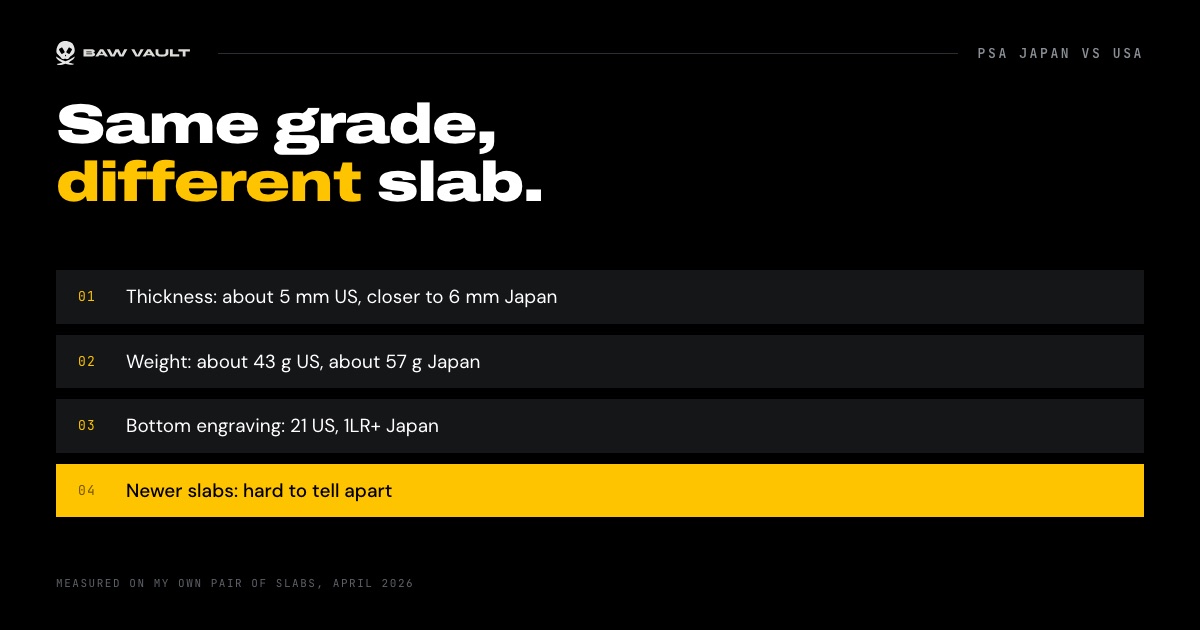
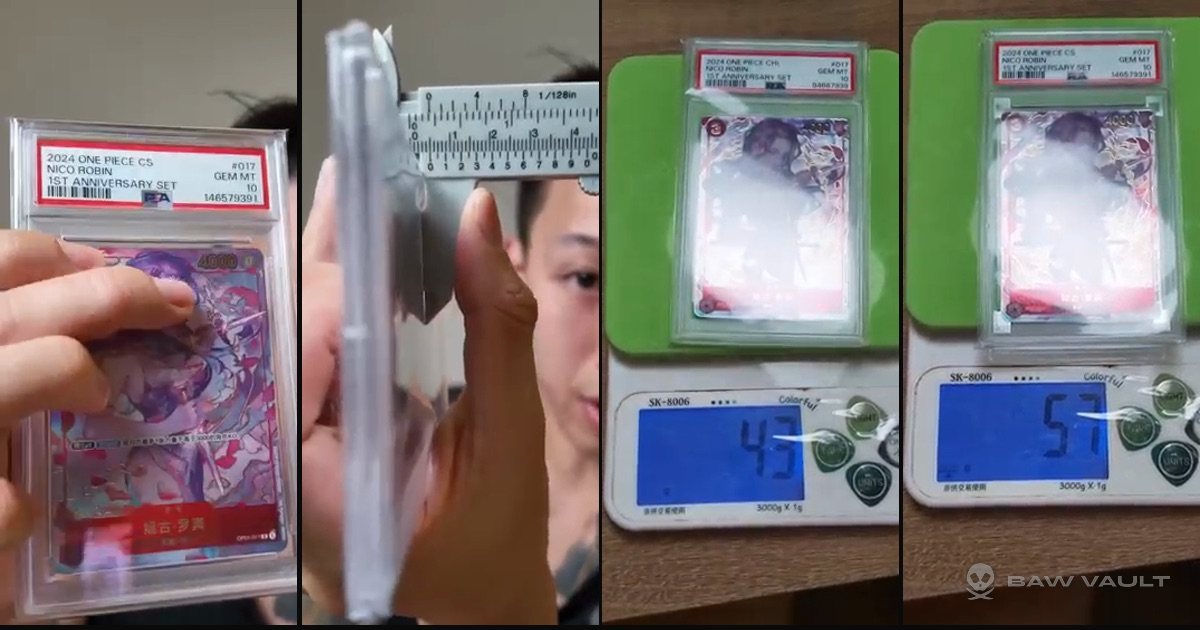
- On my pair, the Japan slab was closer to 6 mm thick and about 57 g; the US slab was about 5 mm and 43 g.
- On the newer slabs I have handled since, I can no longer tell the two apart.
- On the same Simplified Chinese card, older PSA labels say CHI and newer ones say CS, for Chinese Simplified. Same card.
- The slab is not the grade. Check the cert number on PSA's site, whichever office graded it.
I am Singaporean and buy and sell cards out of Kaohsiung. Cards graded through PSA Japan come back in PSA Japan slabs, and one of my 2026 batches went that route. How to get cards graded from Asia in the first place, with costs and wait times, is in the main guide to PSA grading from Asia.
The seven differences
In April 2026 I put an older PSA Japan slab next to a US one, both holding the same One Piece card:
- The Japan slab's inner frame has a small bevel along the top. The US frame is flat.
- The US slab has a small hole on the bottom edge. The Japan slab has none.
- The US slab shows three points from the inner mould. On the Japan slab you can barely see them.
- Thickness: about 5 mm for the US slab, closer to 6 mm for Japan.
- The bottom engraving reads "21" on the US slab and "1LR+" on the Japan one.
- Weight on my scale: about 43 g for the US slab, about 57 g for Japan.
- I have read that Japan slabs from 2024 use a harder, medical-grade plastic. I could not check that one myself.
On the newer slabs I have handled since, I can no longer tell the two apart. Use the list to read an older slab, not to judge a new one.
CHI and CS: two labels for the same Chinese card
I have two copies of the same Simplified Chinese card, the 2024 1st Anniversary Set Nico Robin. One label says CHI, with an eight-digit cert number. The other says CS, with nine.
CS stands for Chinese Simplified. Listings built from PSA's cert records show the same card under two set names: "Chinese" on an eight-digit cert and "Simplified Chinese" on a nine-digit one. So CHI is the earlier, plainer label and CS the newer, more exact one. It is the same card, so do not let the label change what you pay.
What it means for you
- A Japan slab and a US slab carrying the same grade are the same grade. Do not pay more or less for the plastic.
- Look up the cert number on PSA's site before you buy any slab, from any office.
- If an older slab looks unlike either one in this list, ask questions before you pay.
A different-looking slab is not a fake, but check the cert either way: how to check a PSA slab is real.
Still choosing a grader? PSA vs BGS vs CGC covers which slab sells in Taiwan.
For what a PSA 10 is worth to a buyer here, the buylist shows what I pay for raw and PSA 10 copies, and here is how selling to me works.