Blog/What case mapping actually is
How the product is made
What case mapping actually is
The pattern people talk about is real, and it comes from how cases are filled rather than from anything anyone decided. It also will not help you pick a box.
The short version
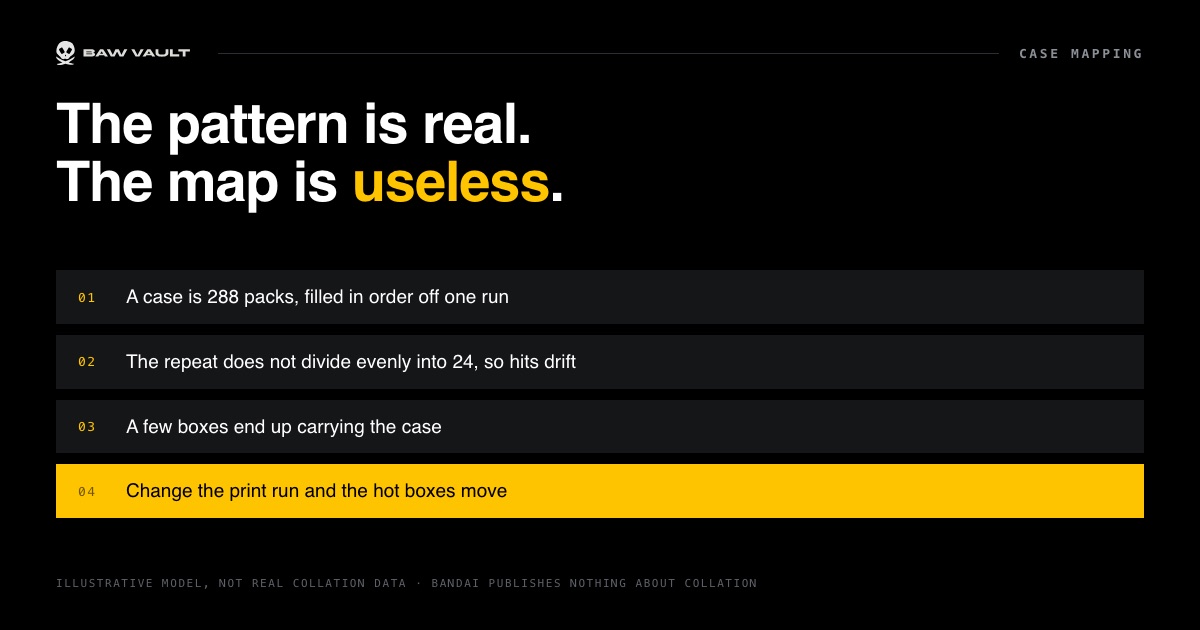
- A case is 12 boxes, 24 packs each, 288 packs, filled in order off one print run. Nothing is shuffled.
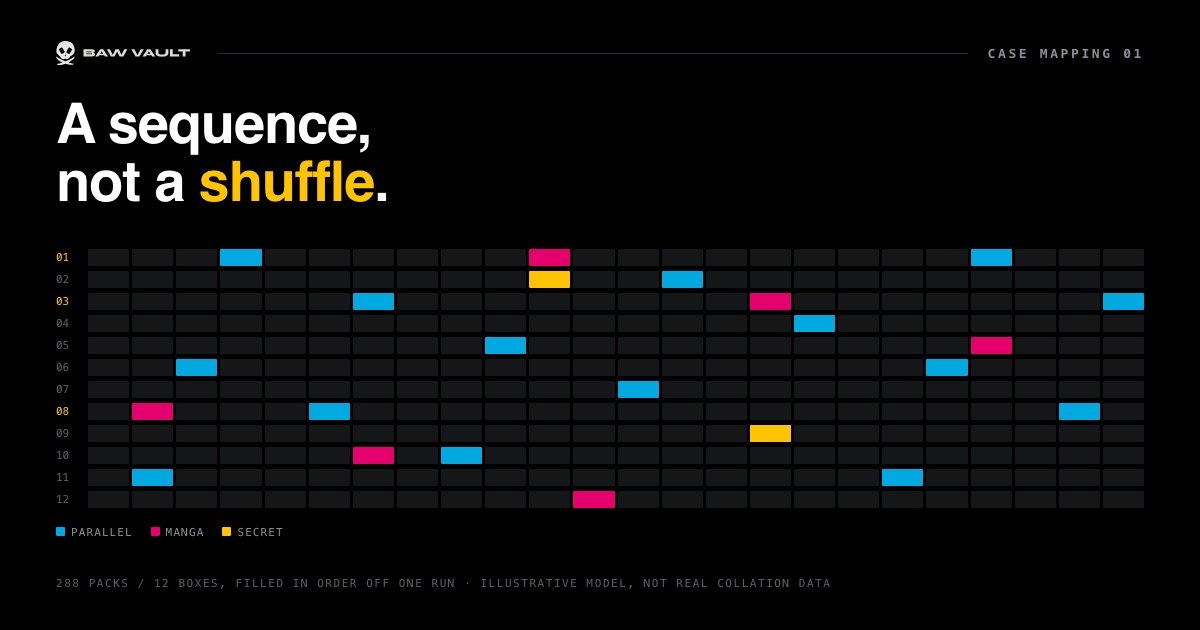
- Hits land at regular spacing because collation repeats. The repeat does not divide evenly into 24, so every box starts at a different point and the hits drift.
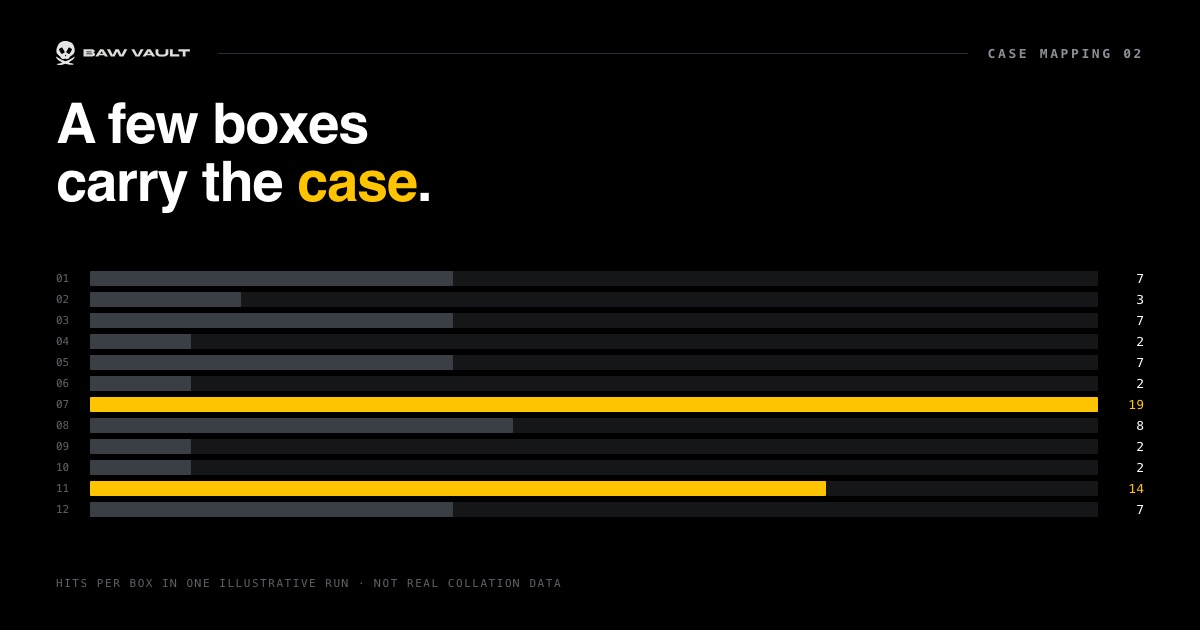
- That is why a case has a shape: a few boxes hold most of the value and a few are close to dead weight.
- Change the print run and the shape moves. You cannot tell which run you are holding from outside the box.
- Bandai publishes nothing about collation. Every number in the diagrams below is an illustration, not real data.
I buy and sell cards out of Kaohsiung, and I did not know this was a thing until recently. What I assumed "mapping" meant was that a case contained a fixed number of hits, so once you pulled a particular card the remaining boxes were dead. That is not it.
What it actually describes is a consequence of how the product is physically made. None of it is official. Bandai has never published anything about collation, and I would not expect them to. People worked it out by opening a great deal of product.
How a case is actually filled
A case is 12 boxes of 24 packs, so 288 packs. Those are the only real numbers on this page. The packs come off one run and get filled in order. Nobody is shuffling them.
Collation repeats, so hits land at regular spacing along that run. Then the run is cut into packs and the packs go into boxes 24 at a time.
Why the hits drift
Here is the part that matters, and it is arithmetic rather than intent. The repeat length does not divide evenly into 24. So each box starts at a different point in the cycle, and the hits drift relative to the box boundaries. They bunch up in some boxes and skip others.
The result is that a case has a shape. A few boxes hold most of the value, and a few are close to dead weight. That shape is the whole reason anyone talks about case mapping.
Why it will not transfer to your case
Shift the starting point and everything moves. A different print run produces a different shape, and the boxes that carried the last one are ordinary in the next.
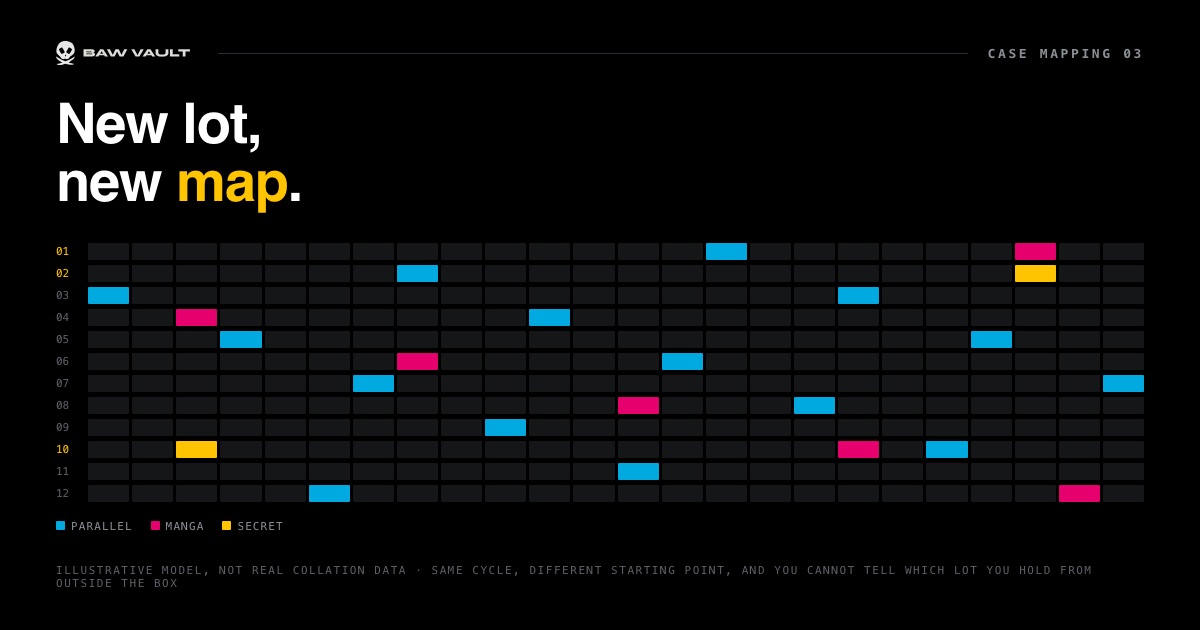
And you cannot tell which run you are holding by looking at the outside of a case. So a pattern someone observed in their product describes their print run, not yours.
Collation reportedly changes between sets, which I would hope it does. Nothing here is fixed forever. It is also said that English print runs are messier than Japanese ones, though that is something I have heard rather than measured.
Could you actually use it?
Honestly, almost certainly not, and this is the part usually left out.
To get anywhere you would need to be receiving stock by the pallet and tracking every single open from that pallet meticulously. After enough volume a pattern might emerge, and you could then check whether it holds for the remaining cases from that same lot. That is the only version of this that works.
With a few cases there is nothing to find. The sample is too small, and you still cannot tell which lot your case came from. Unless you know someone on the print line, good luck.
What it is worth knowing anyway
First, an uneven case is normal. If you open one and most of it is flat, that may not be bad luck in the way it feels; it can be the shape working as described. The singles from the flat boxes still sell, and the buylist shows what I pay for them.
Second, this is a manufacturing quirk rather than a strategy. It explains something you have probably already noticed. It does not tell you which box to buy.
If you want to see it for yourself, next time you rip a case, open it in order and note what comes out of each box. That record is the only version of this that is actually yours, because it came from your case.
The two minute version, with the same diagrams.