
Blog/Are trading cards actually an asset?
What cards actually are
Are trading cards actually an asset?
I sell cards for a living and I am going to argue that they are not an asset class. Not because prices will fall, but because of what a card structurally is.
The short version
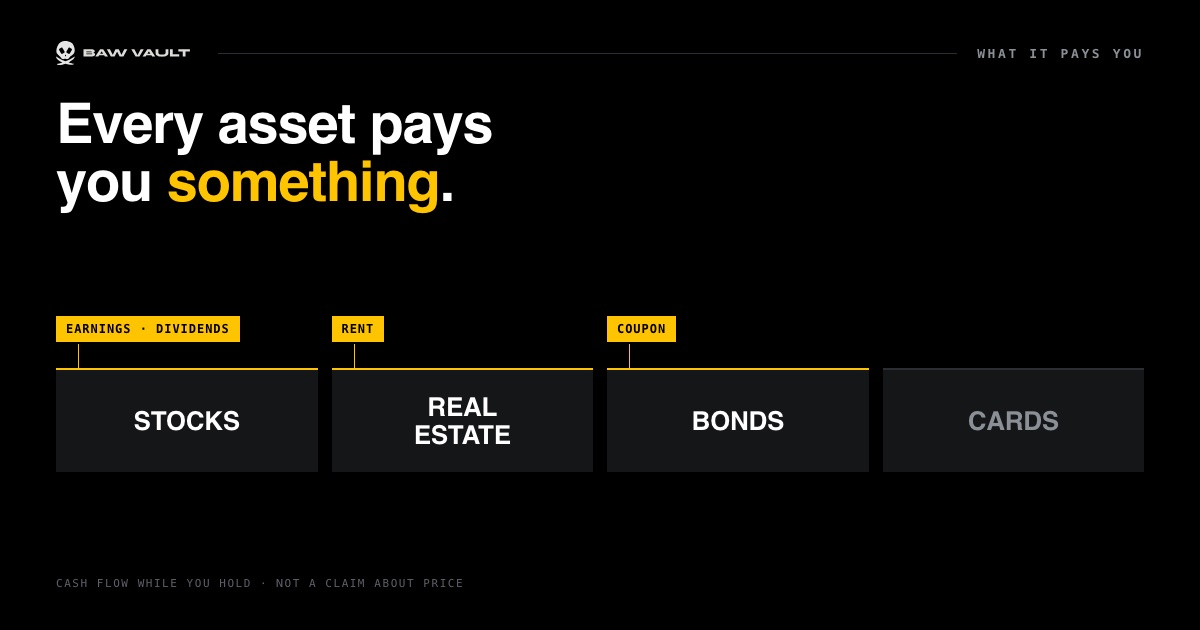
- A stock, a bond and a property all produce something while you hold them. A card produces nothing, ever.
- So the return has one source: somebody paying more later. That is a description of the mechanism, not an insult.
- Supply is controlled by a company with an incentive to print, and your demand is the signal that tells them to.
- Cards are one bet, not a portfolio. A hundred different cards is a hundred ways to be exposed to one publisher.
- Cards can honestly be consumption, or they can be inventory. They are not a retirement plan.
This is the spine of a longer piece on collecting without going broke. It is the part people quote back at me, usually annoyed, so here is the argument in full rather than in a clip.
Start with the mechanism, not the prices
Almost every argument about whether cards are an investment turns into a forecast, and forecasts are worthless. So ignore prices entirely for a minute and look at what the thing is.
A stock is a claim on a business that earns money. Real estate produces rent, or you live in it and it saves you rent. A bond pays a coupon. Every one of those throws off something while you hold it, whether or not anyone wants to buy it from you.
A card produces nothing. Ever. A slab sitting in a case for ten years generates exactly zero. So where does a return come from? One place only: someone paying more for it later than you did. That is the entire engine.
Four structural problems
1. Supply is controlled by a company with an incentive to print
Nobody can print more land. Bandai and Pokémon can print more cards, and demand is exactly the signal that tells them to. The thing that makes your card valuable is the thing that invites more supply. Reprints, anniversary sets, promo runs. This is not a company behaving badly, it is a company behaving normally.
2. It costs money to hold
Grading, shipping, storage, insurance, sleeves, condition risk, fake risk, and your time. A bond pays you to wait. A card charges you to wait. That is the opposite sign, and over ten years the difference compounds against you.
3. No disclosure, no audit, no floor
A public company files audited accounts you can read. Card sales data is thin, self-reported and gameable. There is no filing, no regulator, and no floor under the price. When a price moves you usually cannot find out why.
4. It is one bet, not a portfolio
A hundred different One Piece cards is not diversification. It is a hundred ways to be exposed to one publisher, one player base and one attention cycle. If interest in the game cools, all hundred move together.
The part that actually matters
Cards are a discretionary luxury. They soften exactly when people's money gets tight, which is exactly when you would need to sell.
Real diversification behaves differently from your income. This behaves worse than your income, at the same time as your income. That is the opposite of what a hedge does. If you lose your job in a downturn and need to raise cash, you will be selling into a market full of other people doing the same thing.
Where the other side is right
Some cards have held value for decades, and some people have genuinely done very well. That is real and I am not going to pretend otherwise.
But that is survivorship. You hear about the winner from decades ago and you never hear about the thousands of cards from games that died, printings that were forgotten, or characters nobody ended up caring about. Every collectible boom looks obvious in hindsight, from the winners' side only.
So what are cards, then
Two honest answers, and you should know which one you are doing.
Consumption. A hobby you love, paid for out of money you can afford to spend. This is a completely legitimate reason to buy cards and needs no justification dressed up as investing.
Inventory. A business where you earn a margin for doing work: sourcing, taking risk, holding stock, packing, shipping, showing up. That is a job, and there is nothing dirty about it.
What cards are not is a retirement plan, a savings account, or a substitute for boring assets. Buy the boring things first, then spend the fun money on cardboard with a clear conscience.
This is also why trading is fine and holding-and-praying is not. The trader is paid for work. The holder is paid by the next person, if that person shows up. If you want the practical version of that, see why dealers pay less than the listing price.
This section starts at the final chapter of the full video.
Read next
Collecting TCG without going broke
The full argument this page came from: budgeting, culling, tracking, and what cards actually are.
Why dealers pay less than the listing
What actually sits in the gap between the price you see and the price you are offered.
Current buy prices
What we pay right now, published openly, from recent verified sales.