Blog/Why dealers pay less than the listing price
Selling your cards
Why dealers pay less than the listing price
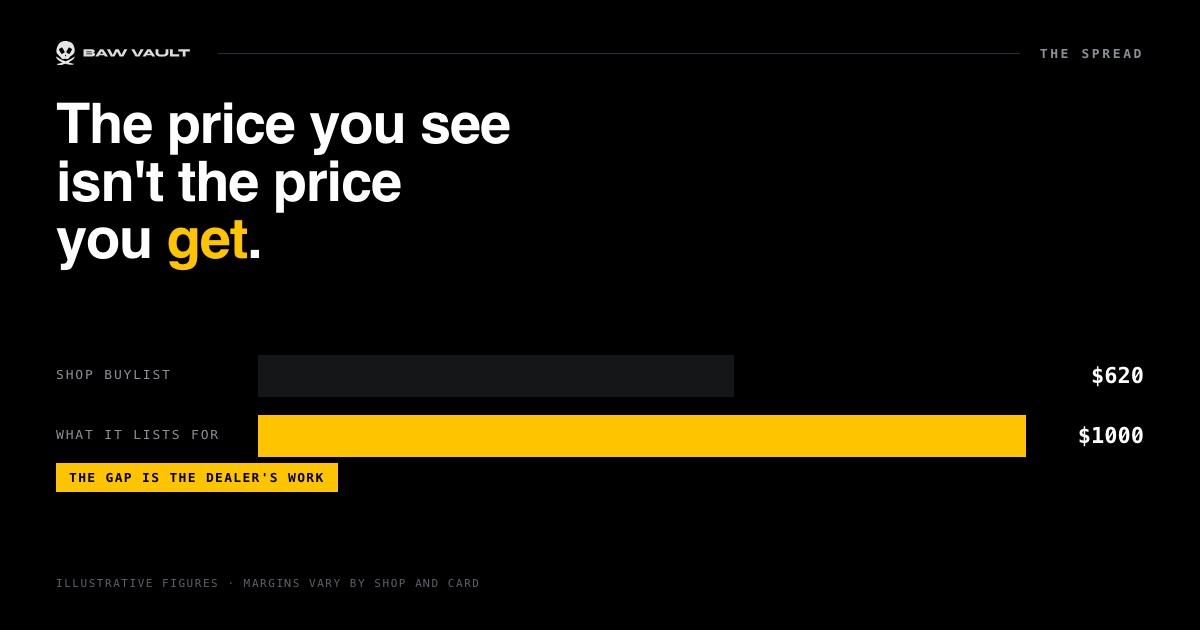
The price you see online is not the price you get. Here is exactly what sits in the gap, from the person quoting you the lower number.
The short version
- The highest listing you can find is an asking price, not a sale. Nobody has agreed to it.
- The gap between what you are offered and what you see is not margin, it is risk, time, fees and the cost of carrying stock that may not move.
- A card might have a handful of real buyers in a given week. That is what makes it worth less than a stock at the same headline price.
- You are choosing between speed and price. Both are legitimate, but you cannot have both.
- Price your own flips off what you can actually get, not off the highest number you can find.
This is one part of a longer piece on collecting without going broke. It is the question I get asked most, usually with some irritation, and it deserves a straight answer rather than a defensive one.
The listing price is an asking price
When you search a card and see a number, that number is somebody hoping. It is not a transaction. Nobody has agreed to it, nobody has paid it, and the listing may have been sitting there for four months precisely because it is too high.
A sold price is different, and even sold prices need reading. A market price on a thin card can be three sales. Sometimes three sales between the same few people.
What is actually in the gap
When I quote you a number below what you found online, that difference is not profit sitting in my pocket. Most of it is things that have to be paid whether the card sells or not.
- Time on the shelf. I pay you today. The card might sell next week, or it might sit for eight months. That money is not doing anything while it waits.
- The risk it never moves. Some cards I buy will not sell at the price I bought them for. That loss has to be priced into everything, including the ones that do sell.
- Condition risk. What looks clean in hand can come back from grading as something else, or a buyer can disagree with my description and I eat the return.
- Fees and shipping. Platform fees, payment fees, packing materials, postage, and the postage on the ones that get returned.
- Fakes and tampering. I have to be right about authenticity every time. Being wrong once is expensive.
- The work. Sourcing, checking, photographing, listing, packing, answering messages, going to shows.
None of that is a favour to you and none of it is a scam. It is what it costs to be the person willing to buy when others are not.
Why cards are worse than stocks on this
This is the part most people have not thought about, and it is the real reason the gap is wide.
A stock has millions of buyers at any moment and the difference between the buy price and the sell price is almost nothing. A card might have a handful of genuine buyers in a given week, in your country, at that price, who are paying attention right now.
Thin markets also mean the visible price can be moved. A small number of buyers can clear the cheap listings and the price becomes whatever is left on the shelf. That is not the market moving, that is a shelf being emptied. If you price your card off that number, you are pricing off an artefact.
You are choosing speed or price
Selling to a dealer is fast, certain, and lower. You get one number, today, for the whole pile, including the boring cards nobody individually wants.
Selling yourself is slower, uncertain, and higher on the good cards. You will also do the photographing, listing, messaging, packing and posting, and you will carry the scam risk and the return risk yourself.
Both are completely legitimate. What is not legitimate is comparing a dealer offer against the highest listing you found and concluding you are being cheated. The honest comparison is the dealer offer against what you would actually net, after fees and after the cards that never sell, divided by the hours it took.
People who actually work that out often find their effective hourly rate is lower than they assumed. Some do it anyway because they enjoy it, which is a fine reason.
What this means for you in practice
Price your own buying and flipping off what you can actually get, not off the highest listing you can find. If you are holding a card because a listing says it is worth a certain amount, check whether anything has actually sold at that number recently.
And when you do want the speed rather than the price, our current buy prices are published openly, from recent verified sales, so you can see the number before you contact anyone.
This section starts at the hype and pricing chapter of the full video.