Blog/Collecting without going broke
Collecting sustainably
Collecting TCG without going broke
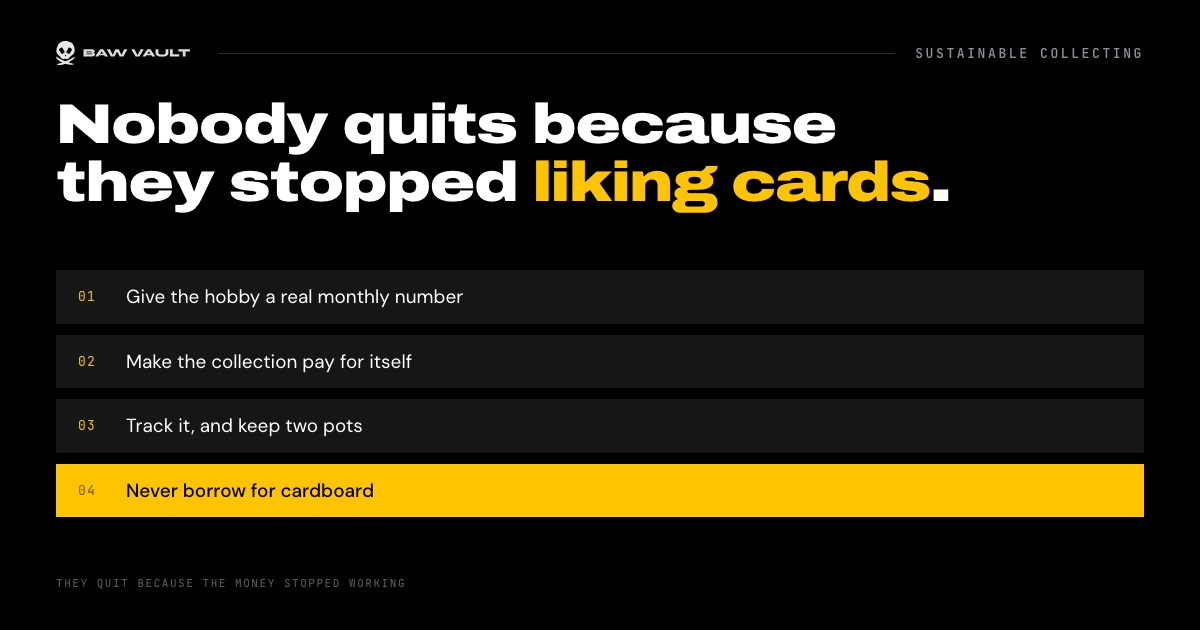
Almost nobody leaves this hobby because they stopped liking cards. They leave because the money stopped working. Here is how to build the money side on purpose.
The full 27 minute version, with English and Traditional Chinese subtitles. Each section below links into the chapter it came from.
The short version
- Give the hobby a monthly number, in its own account, that could vanish without breaking anything in your life.
- Never borrow for cards. Debt turns you into a forced seller, and forced sellers do not pick the price or the timing.
- Run a loop, not a drain: buy multiples where you can, sell the extras, let the keeper be paid for.
- Track every purchase, and keep your personal collection and your inventory in two separate pots.
- Cards produce nothing while you hold them. They can be consumption or they can be inventory. They are not a retirement plan.
I buy and sell One Piece and Pokémon cards out of Kaohsiung, so I see both sides of the deal: the people buying, and the people who eventually have to sell. The same three or four mistakes end collectors every time, and none of them are about picking the wrong card.
This is the written version of my full video on it. Nothing here is financial advice. It is hobby and small business budgeting, from someone who has broken most of these rules himself.
Be a collector and a trader, not just a buyer
The default path is pure consumption. Money in, cardboard out, forever. That path has one ending, and it lands in my inbox most months as somebody asking what their collection is worth.
Buying three copies to sell two and keep one is normal commerce. It is how most collections get funded. Clearing an entire shop's allocation so nobody local can play is a different thing, and that is what people actually mean when they are angry about scalping. Draw the line yourself and stay on the right side of it.
You are a participant in a market, not a victim of one.
Do not be invisible
You do not need to be an influencer. You need to not be a stranger. Posting what you pulled, what you bought, what you think of a set is enough.
What visibility buys is access: allocations, pre-order slots, first refusal on a collection somebody is quietly selling, trade offers from people you would never have met. None of it arrives if you are silent, because nobody offers a deal to a stranger.
If access and allocations genuinely do not matter to you, skip this one. Quiet collecting is a real and fine way to be in this hobby.
Stop comparing
I scroll too. You see collections you do not have and cards you cannot get, and it stings. But the feed is a highlight reel. Nobody posts the loss pile, the box that whiffed, the card they overpaid for, or the credit card bill.
The rule that replaces it: get the cards you can realistically get without damaging your actual life.
Never go into debt for cardboard
This is the one that ends people, and it is not only kids. It is normal collectors, vendors and shop owners who look successful, spending money they do not have.
Here is the mechanism, and it is the part worth sitting with. Debt turns you into a forced seller. A forced seller does not choose the price or the timing, the market does. And you will be forced to sell into the same weak market as everyone else who is also forced.
If you cannot pay for it today, in full, without moving money that was meant for something else, you cannot afford it. That is the whole test.
Give the hobby a real number
The hobby needs a monthly number. Not a vibe, a number. Put it in a separate wallet or account so card money never touches rent money.
The test for whether the number is right: if that money vanished tomorrow, does anything in your life break? If yes, it is too big.
I am not going to tell you mine. But I know exactly what it is, and that is the point.
Make the collection pay for itself
Almost none of us can keep spending forever. So the goal is a loop, not a drain. Buy multiples where you can, sell the extras, and let the keeper be paid for. Cull what you no longer look at, and put that cash back into the hobby wallet, not into your life and not out of it.
The cull rule: if you would not buy it again today at today's price, the only reason you still own it is that you already own it.
From the dealer side, the pattern is consistent. The collections that survive get pruned. The full version of this loop, including the cull rule, is its own page. The ones that die only ever grew. Selling is not betrayal, selling is what keeps you in. When you are ready to prune, our current buy prices show what the boring middle of your collection is actually worth today.
Track it, and keep two pots
Track everything you buy: date, what it was, where it came from, what you paid, fees, what you sold it for, net.
If you are running any kind of flipping side hustle, your personal collection and your inventory are two different pots. Never one pot. People mix them because it feels the same, it is all cards in the same house. Then they cannot tell whether the business made money or whether they quietly ate their own collection.
Even pure collectors should track cost. The first time you total a year is uncomfortable. Do it anyway. Here are the seven columns and the two-pot rule in full. That number lands harder than any rule on this page.
If everyone is talking about it, you already missed it
When a card is all over the feeds and every creator is covering it, the move already happened. By the time it is news you are not early, you are the exit.
Cards are worse than stocks on this, for three reasons:
- Illiquidity. A stock has millions of buyers and almost no spread. A card might have a handful of real buyers in a given week.
- Thin data. A market price can be a few sales. Sometimes a few sales by a few people.
- It is manipulable. A small number of buyers can clear the cheap listings, and now the price is whatever is left. That is not a market moving, that is a shelf being emptied.
Which is also why the price you see online is not the price you get. I am the guy quoting the lower number, and the gap is me carrying stock that might not move, condition risk, fees, shipping and time. Price your flips off what you can actually get, not off the highest listing you can find. This is what actually sits in that gap.
Two questions before you chase anything: do you actually need this card, and if you just want it, can you honestly afford it right now? Want is fine. Want on borrowed money is not.
Cards are not an asset class
A stock is a claim on a business that earns money. Real estate produces rent, or you live in it. A bond pays a coupon. Every one of those throws off something while you hold it.
A card produces nothing. Ever. A slab in a case for ten years generates exactly zero. So the return comes from one place only: someone paying more later. That is a description of the mechanism, not an insult.
Four structural problems follow from it. Supply is controlled by a company with an incentive to print, and demand is exactly the signal that tells them to. It costs money to hold, so a bond pays you to wait while a card charges you to wait. There is no disclosure and no audit. And a hundred different One Piece cards is not diversification, it is a hundred ways to be exposed to one publisher.
Some cards have held value for decades and some people have done genuinely well. That is real, but it is survivorship. You hear about the winner from decades ago, never about the thousands of cards from games that died.
Cards can be consumption, a hobby you love, and that is an honest reason to spend money. Cards can be inventory, a business where you earn a margin for work. What they are not is a retirement plan or a savings account. Buy the boring things first, then spend the fun money on cardboard with a clear conscience. The full argument, with the four structural problems, is worth reading if this one lands wrong.
What actually compounds
The cards do not compound. Your reputation does. Pay fast, ship fast, describe honestly, do not chisel people over small money, show up at the same places. Do that for two years and you get offered things before they hit the internet. Unlike a card, that produces something every year, and nobody can reprint it.
The people still here after ten years have people. The ones who quit were alone with a price app.
The yearly checkup
Three questions, once a year, answered honestly:
- Am I still enjoying this, or just maintaining it?
- Is any of this on money I do not have?
- Did this hobby cost me anything outside the hobby this year?
Bad answers do not mean quit. They mean shrink, cull, and re-set the number.